
If the back of your tow vehicle sags when you hitch up, your headlights point at the treetops, or the rig feels light and skittish through the front end, a weight distribution hitch is what fixes it. A WDH spreads your caravan’s tow ball weight back across the tow vehicle’s front axle and the van’s axles instead of dumping it all on the rear, which restores your steering, braking and ride height. This guide covers when you actually need one, what to look for, and the best weight distribution hitches in Australia for 2026.
What A WDH Does (And When You Need One)
A weight distribution hitch uses spring bars under tension to take the download pressing on your tow ball and spread it forward onto the tow vehicle’s front axle and back onto the van’s axles. The result is a level rig: the vehicle sits back down on its front wheels, so your steering bites, your headlights aim where they should, your brakes work properly and the whole combination feels planted instead of tail-heavy.
You need one if your van is heavy on the tow ball and your rig sits nose-up or tail-down once hitched, or feels vague and wandery to steer. Most caravans put 8 to 10% of their loaded weight on the ball, which on a 2.5-tonne van is 200 to 250kg pressing straight down on the back of your car. That’s enough to upset most tow vehicles.
You may not need one if your van’s tow ball weight is comfortably within your vehicle’s limits and the rig already tows level and stable. Don’t fit a WDH just because everyone else has one. And to be clear about what it can’t do: a WDH redistributes weight, it does not raise your legal towing capacity or your tow ball download limit. You still have to be within every rating.
A WDH is an on-road tool. With an off-road articulating coupling like a DO35, you disconnect the spring bars before serious off-road tracks, because the tension restricts the articulation the coupling is designed to give. Some tow vehicles and some vans (certain independent-suspension and electronic stability setups) are not approved for a WDH at all, so check both your vehicle handbook and your van manufacturer before fitting one.
What To Look For When Buying
Getting the right WDH is mostly about matching it correctly to your rig. Here’s what matters.
- Match it to your tow ball weight: This is the single most important spec. WDH kits are rated by ball weight range (for example 135–275kg or 275–365kg). Weigh your loaded van’s tow ball weight and buy the kit that brackets it. Too light and the bars won’t do the job; too heavy and they’ll be harsh.
- Spring bar style and clearance: Round and trunnion (truncated) bars sit higher and give more clearance under a 5″ or 6″ off-road chassis. Make sure the kit suits your A-frame depth and whether your coupling plate is mounted on the top or bottom of the A-frame.
- Sway control: Some WDH heads include a built-in friction sway tab, and some kits (like the Eaz-Lift Recurve or Fastway e2) build sway control right in. Others run separate add-on sway control. Decide whether you want it integrated or bolted on.
- Coupling compatibility: If you run a pin coupling like a DO35 or McHitch, you’ll need the matching WDH post or adaptor so the head carries your pin rather than a tow ball.
- Shank height: The shank sets the hitch height. Measure the height from the ground to your van’s coupling and to your vehicle’s receiver, and pick a shank that levels the two up.
- Brand support and warranty: Spare parts and service on the road matter. Established brands with a dealer network are worth it when you’re a long way from home.
Get your WDH set up by someone who knows what they’re doing, or follow the brand’s procedure carefully. A wrongly tensioned WDH can make handling worse, not better. The aim is the tow vehicle sitting down evenly by roughly 15 to 20mm front and rear with the van dead level.
The Best Weight Distribution Hitches For 2026
Prices vary with the kit rating and whether you buy the shank separately, so treat these as a guide and match the kit to your ball weight.
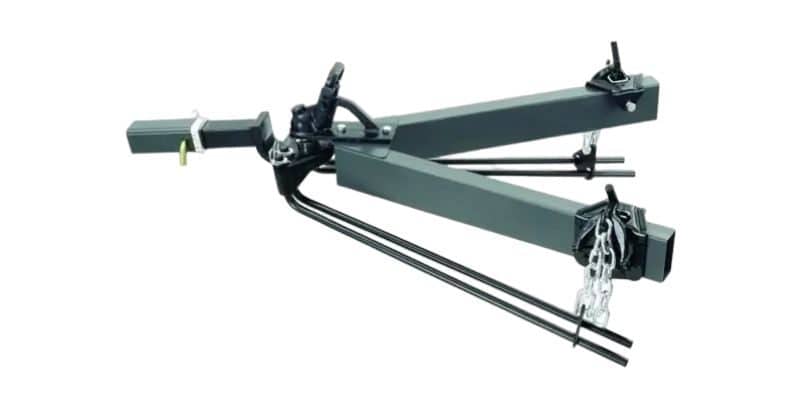
✔ Pros
- Australian made and engineered for our conditions
- Full range to match any ball weight
- DO35 and McHitch posts available
- Lifetime warranty, parts everywhere
✗ Cons
- Add-on sway control costs extra
- Choosing the right kit and shank takes some measuring
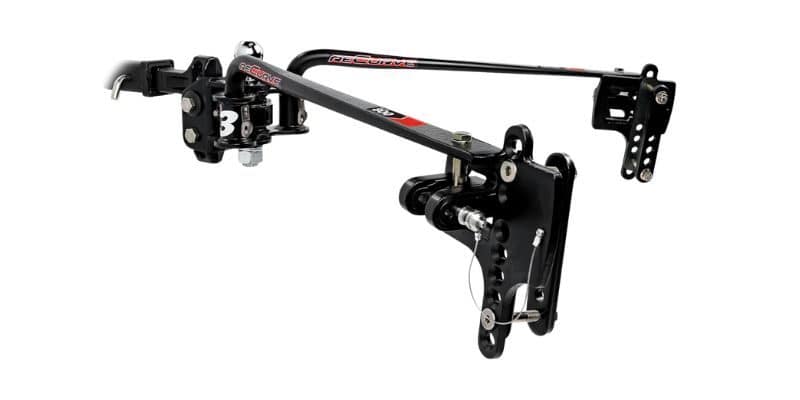
✔ Pros
- Built-in adjustable sway control
- Cheaper than premium rivals
- Simple to dial in
- Widely stocked
✗ Cons
- Less local support than Hayman Reese
- Round bars suit top-mount A-frames best
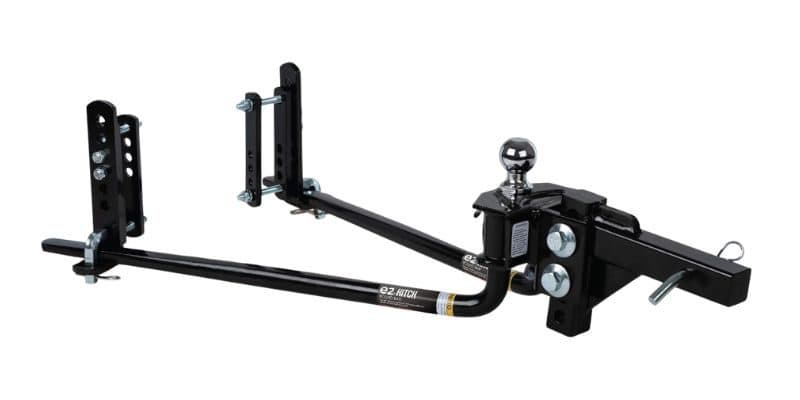
✔ Pros
- Sway control built in, no add-ons
- Round or trunnion bar options
- Clean, all-in-one setup
- Well regarded by long-haul travellers
✗ Cons
- Dearer than the Eaz-Lift
- Less local parts support than Hayman Reese
Also Worth A Look
For the strongest sway control money can buy, the Equal-i-zer uses a four-point system built into the hitch and is a premium favourite for heavy or sway-prone rigs, though you’ll pay for it. At the other end, the Andersen No-Sway is a lightweight chain-tension system that’s far easier to hook up and quieter than spring bars, popular with anyone who finds a traditional WDH a pain to connect, though it’s a premium price for the convenience. Both are worth a look if the big three above don’t quite fit your needs.
Quick Comparison
| System | Price | Ball Weight | Sway Control | Best For |
|---|---|---|---|---|
| Hayman Reese WDS Pick | ~$450–800 | 135–545kg | Friction tab + add-on | Almost everyone |
| Eaz-Lift Recurve R3 Value | ~$350–550 | Model-dependent | Integrated, adjustable | Value + integrated sway |
| Fastway e2 | ~$550–800 | Model-dependent | Integrated, 2-point | All-in-one setup |
| Equal-i-zer | ~$700–1,000 | Model-dependent | Integrated, 4-point | Heavy / sway-prone rigs |
| Andersen No-Sway | ~$700–900 | Model-dependent | Chain tension | Easy hook-up, lighter |
The Verdict
For most big lappers with a heavy-nosed on-road tourer, buy a Hayman Reese Weight Distribution System matched to your loaded tow ball weight. It’s Australian made, backed for life, supported everywhere, and it just works. If you’d rather have weight distribution and sway control in one and save some money, the Eaz-Lift Recurve R3 is the value pick, with the Fastway e2 a step up for an integrated all-in-one.
Whatever you choose, the rules are the same: match the kit to your ball weight, set it up properly so the rig sits level, and remember a WDH doesn’t raise any of your weight limits. If you head off the blacktop with an articulating coupling, disconnect the spring bars first, and always check your vehicle and van both allow a WDH before you fit one. Sway control is a related but separate topic, so if that’s your main worry, read on.
- A WDH spreads tow ball weight across all axles so your rig sits level and steers, brakes and tracks properly.
- Match the kit to your loaded tow ball weight, that’s the spec that matters most.
- Hayman Reese is the Aussie default; Eaz-Lift Recurve R3 is the value pick with integrated sway.
- A WDH doesn’t raise any weight limit, and you disconnect it for serious off-road articulation.
- Check both your vehicle and van manufacturer allow a WDH before fitting one.

Comment (0)