
Your house battery is the heart of your caravan’s 12V system. Everything that runs when you’re not plugged into mains power draws from it: lights, the water pump, USB charging, your fridge, the range hood fan, and any 12V accessories you’ve added. The battery’s capacity determines how long you can camp independently, and choosing the right battery system is probably the most impactful gear decision you’ll make for off grid travel.
This guide covers what makes a caravan battery different from a car battery, the types available, how to work out what capacity you need, and specific product recommendations at every price point. If you’re new to caravan power systems, start with our guide to how your caravan’s electrical system works before diving into buying decisions.
What Is a Deep Cycle Battery?
Before looking at specific products, you need to understand one fundamental distinction: deep cycle batteries are not the same thing as car batteries, and your caravan needs a deep cycle.
A regular car battery (called a cranking or starter battery) is designed to deliver a massive burst of power for a few seconds to start the engine, then get immediately recharged by the alternator. It sits near full charge almost all the time. If you discharge a cranking battery slowly overnight, the way a caravan uses power, it will be damaged within weeks.
A deep cycle battery is designed for exactly the opposite job: slow, sustained discharge over hours (running your fridge, lights, and water pump overnight) followed by gradual recharging from solar, driving, or mains power. The internal construction is different, with thicker lead plates in lead acid versions and different cell chemistry in lithium, allowing repeated deep discharge without damage.
Every caravan house battery must be a deep cycle battery. This isn’t a premium option or an upgrade. It’s the correct battery type for the job. When shopping, you’ll see “deep cycle” on the label of every battery designed for caravan, marine, or off grid use. If it doesn’t say deep cycle, it’s the wrong battery.
Your tow vehicle’s starter battery and your caravan’s house battery do completely different jobs. Never use a cranking battery as a house battery, and never try to start your car with a deep cycle. They’re engineered for different purposes.
Battery Types Explained: AGM, Lithium & Gel
All caravan house batteries are deep cycle, but they come in three main chemistries. The choice between them affects capacity, weight, lifespan, cost, and how your entire power system needs to be configured.
AGM (Absorbed Glass Mat)
AGM batteries are the standard fitment in most new caravans. They’re sealed lead acid batteries that use fibreglass mats to absorb the electrolyte, making them maintenance free and safe to mount in any orientation inside the van. AGMs are affordable, widely available at battery retailers and auto shops across Australia, and well understood technology.
The critical limitation is depth of discharge. AGMs should not be discharged below 50% state of charge. Going deeper shortens their lifespan dramatically. A 100Ah AGM battery effectively gives you around 50Ah of usable capacity. Typical lifespan is 300 to 500 cycles at 50% depth of discharge, which translates to roughly two to four years of regular use. Weight is also significant: a 100Ah AGM weighs around 28 to 32kg.
Price range: $200 to $400 for a quality 100Ah deep cycle AGM.
Lithium Iron Phosphate (LiFePO4)
Lithium batteries have become the go to upgrade for serious Big Lappers, and the price drop over the last few years has made them accessible to a much wider audience. LiFePO4 is the specific lithium chemistry used in caravans. It’s the safest lithium chemistry available, with excellent thermal stability and no risk of the thermal runaway issues associated with other lithium types like those in phones and laptops.
The advantages over AGM are substantial. You can safely discharge to 80 to 100% of rated capacity, so a 100Ah lithium battery gives you 80 to 100Ah of usable power compared to 50Ah from an equivalent AGM. They last 2,000 to 5,000+ cycles, roughly seven to fifteen years of regular use. They weigh about a third of an equivalent AGM. They charge significantly faster, meaning less time on the generator or at a powered site. And they maintain voltage more consistently as they discharge, so your appliances run properly right down to low charge levels rather than dimming and struggling as AGMs do below 60%.
The downside is upfront cost. A quality 100Ah lithium battery costs $700 to $1,500, roughly three to four times an equivalent AGM. However, when you factor in the doubled usable capacity and five to ten times longer lifespan, the cost per usable amp hour over the battery’s life is actually lower than AGM. It’s a bigger initial outlay that saves money over time.
Price range: $700 to $1,500 for 100Ah. $1,500 to $3,000 for 200Ah.
Gel (Gel Cell)
Gel batteries use a gelled electrolyte and are occasionally found in older caravans. They handle deep discharge slightly better than standard flooded lead acid batteries and roughly on par with AGM, but they charge slowly, are sensitive to overcharging (which can permanently damage the gel), and cost more than AGM without offering any meaningful advantage for caravan use. If your van currently has gel batteries and they’re still performing well, keep using them. When replacement time comes, upgrade to AGM or lithium.
If upgrading from AGM to lithium, your caravan’s charging system (DC DC charger, solar charge controller, and 240V charger) must be compatible with lithium batteries or reprogrammed for them. Charging a lithium battery with a charger profiled for AGM can damage the battery and void the warranty. Check compatibility before purchasing, and budget for charger upgrades if needed.
AGM vs Lithium: The Real World Decision
This is the decision most readers are here to make, so let’s address it directly before getting into specific products.
Stick with AGM if: You’re on a tight budget, you mostly stay at powered caravan parks, you free camp occasionally for one or two nights between park stays, or you’re buying a second hand van and aren’t sure yet how much free camping you’ll actually do. A pair of quality 120Ah AGMs ($600 to $800 total) gives you around 120Ah of usable capacity, which handles a night or two of free camping comfortably. AGMs are also the pragmatic choice if your existing chargers, solar controller, and DC DC charger aren’t lithium compatible, because the cost of replacing all of those on top of the battery makes the total upgrade bill much steeper.
Upgrade to lithium if: You plan to free camp regularly (more than a few nights per week), you need to run higher draw appliances off grid, weight is a concern (lithium saves 15 to 30kg over equivalent AGM capacity), or you want the long term cost savings of a battery that will outlast two or three sets of AGMs. A 200Ah lithium system with compatible charging equipment is $3,000 to $5,000 installed, but it gives you near complete energy independence with adequate solar.
The middle ground: Start with AGM, assess your actual needs over the first few months on the road, and upgrade to lithium when (and if) you find the AGMs genuinely limiting. Many Big Lappers do exactly this, and it’s the lowest risk approach. You’ll know within a month of free camping whether your battery capacity is the bottleneck.
What To Look For When Buying
Not all batteries with the same amp hour rating are equal. These are the features that separate a good caravan battery from a mediocre one.
- Usable capacity: The headline amp hour rating isn’t the full story. For AGM, halve it. For lithium, check what the BMS actually allows; some cheaper units cut off at 80% depth of discharge, not 100%.
- Cycle rating: This tells you how many charge/discharge cycles the battery is rated for at a specific depth of discharge. More cycles = longer lifespan. Compare at the same depth (e.g., 2,000 cycles at 80% DoD is more useful than 5,000 cycles at 50% DoD).
- BMS features (lithium only): The Battery Management System protects against overcharge, over discharge, short circuit, and over temperature. Better units add low temperature charge cutoff (important in cold climates, as charging lithium below 0°C can damage cells), cell balancing, and Bluetooth monitoring via a phone app.
- Physical dimensions: Not all batteries fit all battery boxes. Measure your existing battery compartment before ordering. Slim line lithium batteries are available from several brands for tight spaces.
- Weight: Matters more than you think when payload is tight. A 200Ah lithium (around 25kg) versus two 120Ah AGMs (around 65kg combined) saves 40kg of payload for other gear.
- Warranty and local support: Australian brands with local warranty support are worth the premium. Claiming warranty on a battery bought from an overseas seller through eBay is effectively impossible.
- Bluetooth monitoring: Most quality lithium batteries now include Bluetooth, letting you check state of charge, voltage, current, and temperature from your phone. It’s genuinely useful, not a gimmick.
Our Top Picks for 2026
These recommendations are based on real world performance in Australian conditions, warranty support, community feedback, and value for money. We’ve grouped them by price tier so you can jump straight to your budget.
Premium Lithium ($2,200+)
This is where you’re paying for the best build quality, the longest warranties, the most advanced BMS features, and tight integration with a broader power system ecosystem. If you’re building a new system from scratch or want the peace of mind that comes with top tier gear and local support, this is the tier to shop in.
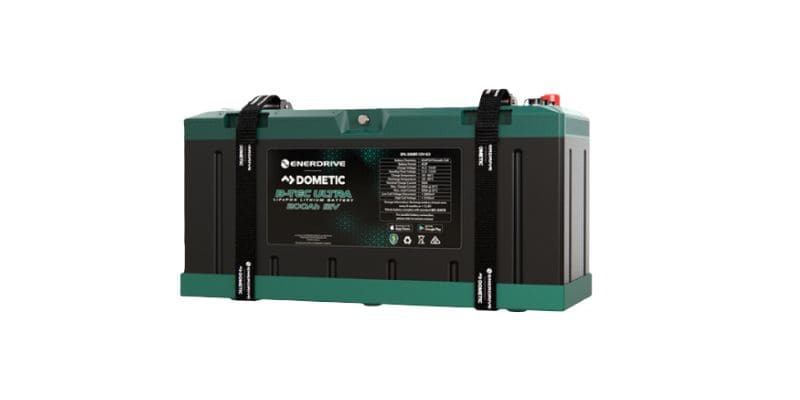
✔ Pros
- Excellent BMS with low temp cutoff and Bluetooth
- Integrates with Enerdrive inverter chargers and monitoring
- 7 year warranty with Australian support
- Proven track record across thousands of Australian rigs
✗ Cons
- Premium price point
- Best value when paired with Enerdrive ecosystem
- 200Ah model is large; check your battery box dimensions
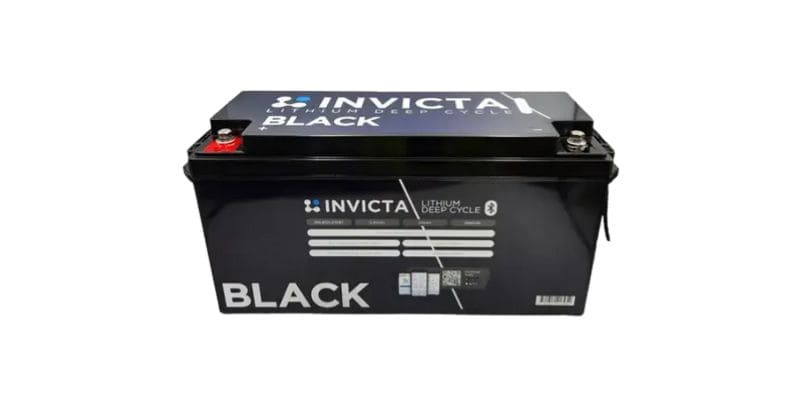
✔ Pros
- 300Ah in a single battery: ideal for high draw setups
- Premium Invicta Black series build quality
- Available through established Australian retailers
- Excellent usable capacity for extended free camping
✗ Cons
- 5 year warranty shorter than Enerdrive
- Heavy at 34kg: not a lightweight option
- Overkill for caravanners with modest power needs
Mid Range Lithium ($1,400 to $2,200)
The sweet spot for most Big Lappers. You’re getting quality lithium cells, a solid BMS, Bluetooth monitoring, and Australian warranty support without paying for top tier ecosystem integration. These batteries work with any brand of charger and controller, which gives you more flexibility in how you build your system.
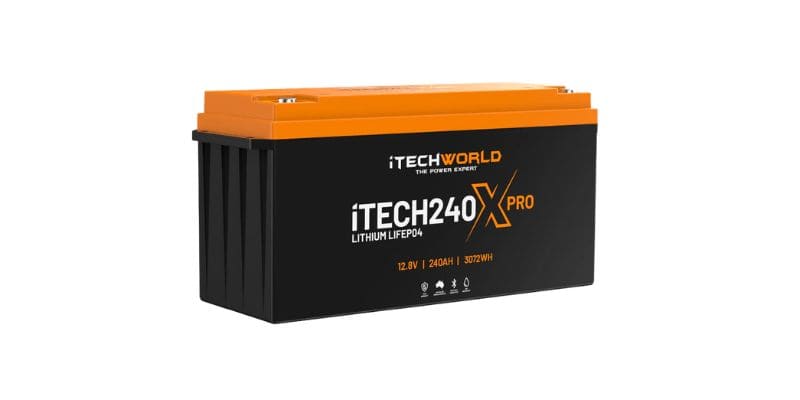
✔ Pros
- 240Ah capacity beats most 200Ah competitors at similar pricing
- Upgraded BMS with improved cell balancing
- Bluetooth monitoring included
- Australian company with local support
✗ Cons
- No proprietary ecosystem integration
- Smaller support network than Enerdrive
- Some users report the Bluetooth app can be unreliable
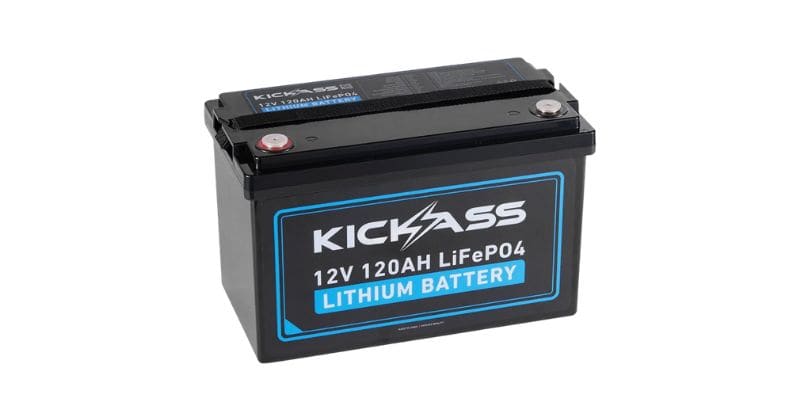
✔ Pros
- Accessible price point for a branded lithium battery
- Lightweight at 14kg
- Good option for modest power needs or as a secondary battery
- Available through established Australian outdoor retailers
✗ Cons
- 120Ah may not be enough for full time free camping couples
- Shorter warranty than mid range and premium options
- BMS features not as advanced as higher tier products
Budget Lithium (Under $1,000 for 100Ah)
If your budget won’t stretch to a mid range unit, a budget lithium is still a significant upgrade over AGM. You’ll get roughly 80 to 90Ah of usable capacity from a 100Ah unit (compared to 50Ah from a 100Ah AGM), faster charging, and much longer lifespan. The trade offs at this tier are simpler BMS features, shorter warranties, and less after sales support.
Kings (Adventure Kings) 100Ah LiFePO4 (~$500 to $700): Sold through 4WD Supacentre, Kings lithium batteries are by far the cheapest brand name option. They work, and plenty of travellers use them without issues. The BMS is basic (no low temperature cutoff on most models), the cycle rating is lower than mid range brands, and if something goes wrong on the road, support options are limited compared to Enerd
Comment (0)