
A tyre blowout at 100km/h while towing a caravan is one of the most dangerous things that can happen on the road. It can cause a catastrophic sway event that even an experienced driver may not be able to recover from. The frustrating part: most blowouts are preventable. They’re almost always caused by underinflation, overloading, or a slow puncture that went undetected.
A Tyre Pressure Monitoring System (TPMS) watches your tyre pressures and temperatures in real time while you drive. If a tyre starts losing pressure or running hot, you get an alarm before it becomes a blowout. For a tow vehicle and caravan combination, where you can’t easily check the van’s tyre pressures while driving and a rear tyre failure can be invisible from the cabin until it’s too late, it’s close to essential.
How TPMS Works
A TPMS system has two components: sensors on each tyre and a display unit (or smartphone app) in the cabin.
The sensors measure tyre pressure and temperature and transmit the data wirelessly to the display. Most systems use RF (radio frequency) transmission, while newer systems use Bluetooth to send data directly to your phone. The display shows real-time pressure and temperature for each tyre and sounds an alarm if any reading goes outside your preset thresholds.
For towing, a TPMS system needs enough sensor capacity to cover both the tow vehicle and the caravan. A typical setup requires 4 sensors for the tow vehicle plus 2-4 for the caravan (depending on whether it’s single or tandem axle), so look for systems that support 6-8+ sensors.
External vs Internal Sensors
This is the biggest decision you’ll make when choosing a TPMS.
External sensors screw onto the outside of your existing valve stems, replacing the dust cap. They’re easy to install (hand-tight, no tools), easy to swap between vehicles, and easy to replace if one fails. The downside is they’re exposed to the elements, and they add a small amount of weight to the valve stem. Anti-theft lock nuts are usually included or available.
Internal sensors mount inside the tyre, attached to the valve stem on the inside of the rim. They’re invisible from outside, protected from weather and theft, and typically more accurate. The downside is installation: you need a tyre shop to break the bead, and if a sensor battery dies, you need to break the bead again.
For most Big Lappers, external sensors are the way to go. They’re cheaper, easier to install, and if you decide you want internal sensors later, you can upgrade without replacing the display unit.
What To Look For
Sensor Capacity
Count your tyres. A dual-cab towing a single-axle caravan needs 6 sensors minimum. A dual-cab towing a tandem-axle caravan needs 8. If you want to monitor spares too, add one or two more. Buy a system that supports at least 6 sensors, ideally 8+.
Signal Range
The signal needs to reach from your caravan’s rear tyres to the display unit in your tow vehicle’s cabin. For a large caravan, that can be 8-10+ metres. Most quality systems handle this fine, but check the rated range and consider whether your rig needs a signal booster (some brands offer these as add-ons).
Stationary Monitoring
This is a feature most people don’t think about until they need it. Some TPMS sensors go to sleep when the vehicle is stationary and only wake up at speeds over 25km/h. If your caravan has been sitting in storage for weeks with a slow leak, you won’t know until you’re driving. Look for a system with stationary monitoring that transmits data even when the vehicle isn’t moving.
Auto-Calibrating Alerts
Setting high and low pressure alarms for each tyre, with different thresholds for the tow vehicle (say 36 PSI) and caravan (say 65 PSI), can be fiddly. Some systems auto-calibrate: you screw the sensors on at your correct cold pressure, and the system automatically sets alarm thresholds based on that reading (typically alarming at 15% below and 25% above). This makes setup dramatically easier.
If your caravan is longer than 8 metres from the display unit to the rear tyres, check whether the TPMS brand offers a signal booster. Some systems lose signal on longer rigs, especially if there’s electronic interference from other devices. A booster (~$50-80) solves this.
Our Top Picks
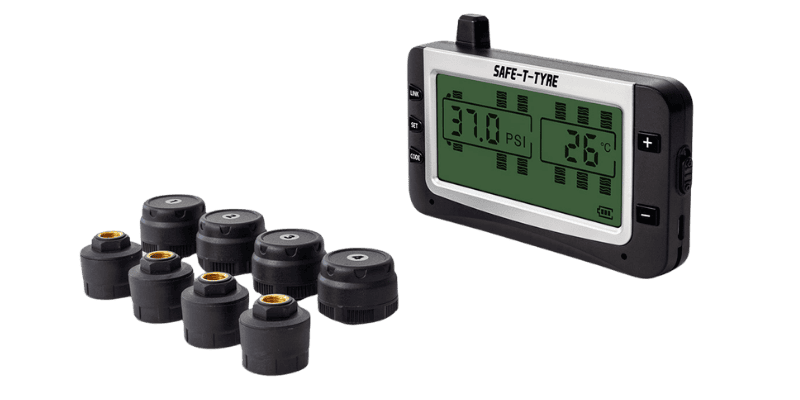
✔ Pros
- Most established TPMS brand in Australian caravanning
- Up to 22 sensors for any rig configuration
- 80-hour rechargeable battery on the display
- “Disconnect trailer” button prevents false alarms when unhitched
- Includes spare CR1632 batteries and stainless steel valve caps
- Australian company with 1800 phone support
✗ Cons
- No auto-calibrating alerts (manual pressure threshold setup)
- No stationary monitoring (sensors sleep when vehicle stops)
- Display adds another device to the dashboard
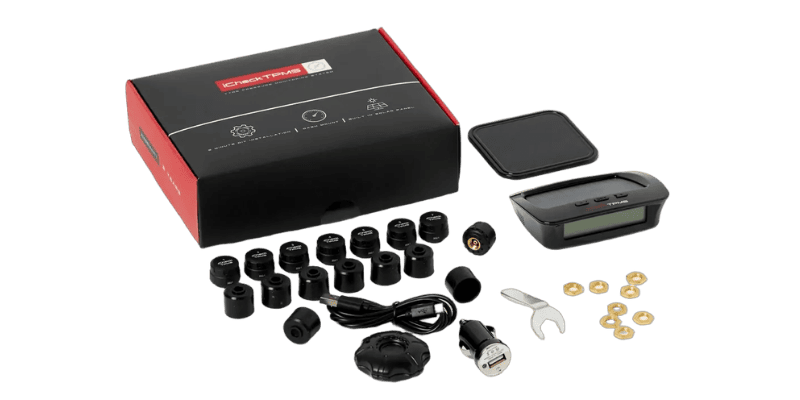
✔ Pros
- Auto-calibrating alerts (no manual setup per tyre)
- Stationary monitoring every 5 minutes (InstaData)
- On/Off-Road mode adjusts alerts without resetting thresholds
- Optional hub temperature monitoring (unique feature)
- Solar-powered display, no battery recharging needed
- IP67 sensors, dustproof and waterproof
✗ Cons
- 7-8m signal range may need a booster for longer rigs
- Max 10 sensors (Safety Dave supports 22)
- Newer brand than Safety Dave or Tyredog
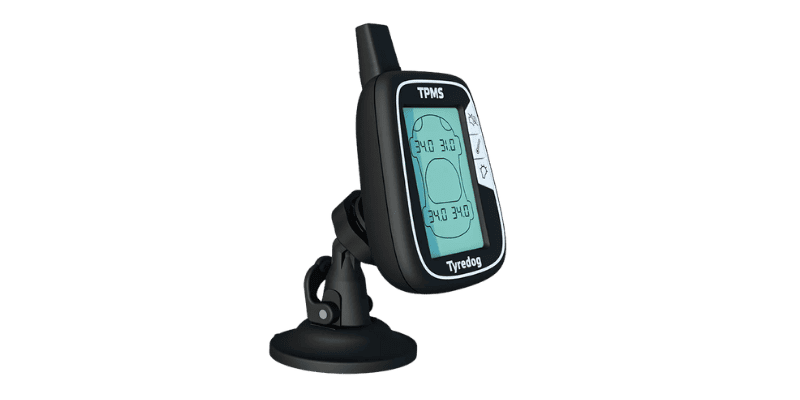
✔ Pros
- Well-established brand with strong community reputation
- External and internal sensor options
- Proven reliability over many years
- Competitive pricing
✗ Cons
- No auto-calibrating alerts
- No stationary monitoring
- Fewer innovative features than iCheck
Other Options
The Oricom TPMS10-6E is another solid option available through Outback Equipment. Oricom is a well-known Australian electronics brand (they also make UHF radios), so the build quality and local support are reliable. Check price at Outback Equipment →
The Tuff Terrain TPMS (8 Sensor) is a budget-friendly option from the Outback Equipment house brand. A good entry point if budget is your primary concern. Check price at Outback Equipment →
Bluetooth TPMS: Worth It?
Bluetooth TPMS systems connect directly to your smartphone via an app, eliminating the need for a dedicated display unit. They’re typically cheaper, and the idea of monitoring everything from your phone sounds appealing. But there are real-world trade-offs to consider.
The biggest limitation is range. Bluetooth’s effective range is roughly 10-15 metres in open air, but in practice, the signal from a caravan’s rear tyre to a phone in the tow vehicle’s cabin can drop out, especially on longer rigs with metal structures between the sensor and the phone. Several users report losing signal to rear caravan sensors entirely while driving.
The other issue is that phone-based monitoring requires the app to be running. If your phone goes to sleep, you lose monitoring. If you’re using your phone for navigation (which most Big Lappers do), the TPMS app may not send audible alerts while in the background. A dedicated display unit monitors constantly without any of these complications.
That said, Bluetooth systems are improving, and they’re better than no monitoring at all. Two options to consider:
The OBD2 Australia Bluetooth TPMS (~$50-80) is a budget 4-sensor external kit that connects via Bluetooth to your phone. A good entry-level option if you want to try TPMS monitoring without a big investment. Check price at OBD2 Australia →
The BMPRO SmartPressure integrates with BMPRO’s Smart RV ecosystem (JHub, Odyssey, JAYCOMMAND). If your caravan already runs BMPRO’s connected system, this adds tyre monitoring to the same platform. However, user reviews are mixed: the Bluetooth range struggles to reach from the caravan to the tow vehicle while driving, and the app needs to be actively open to receive alerts. It works well for stationary monitoring at camp, but less so as a driving safety tool. Check price at Caravan RV Camping →
A TPMS supplements your manual pressure checks, it doesn’t replace them. Check your pressures cold with a quality digital gauge before every driving day. TPMS sensors can lose calibration over time, and external sensors can be affected by dust, water, and vibration. Trust your gauge for the baseline; trust your TPMS for real-time alerts while driving.
Quick Comparison
| System | Sensors | Display | Price | Standout Feature | Best For |
|---|---|---|---|---|---|
| Safety Dave Best Pick | 4-22 | 3.5″ LCD | ~$359-489 | Up to 22 sensors, 1800 phone support | Most towing setups |
| iCheck IC008 Best Features | 8 (exp. to 10) | Solar colour LCD | ~$370 | Auto-calibrating, stationary monitoring | Set-and-forget, off-road |
| Tyredog | 4/6/8 | Dedicated unit | ~$200-350 | Proven reliability | Reliable no-frills option |
| Oricom TPMS10-6E | 6 | Dedicated unit | ~$200-280 | Trusted electronics brand | Alternative mid-range |
| Tuff Terrain 8 Sensor | 8 | Dedicated unit | ~$150-200 | Budget-friendly | Entry-level |
| Bluetooth (various) | 4-8 | Smartphone app | ~$50-150 | No display unit needed | Budget, tow vehicle only |
The Verdict
If you’re towing a caravan, a TPMS is one of the best investments you can make in road safety. A tyre blowout on a loaded caravan at highway speed is genuinely dangerous, and most blowouts start as slow pressure losses that a TPMS would catch long before they become catastrophic.
For most Big Lappers, the Safety Dave TPMS is the safest choice. It has the longest track record, the best local support (1800 phone line, presence at every major caravan show), and the flexibility to monitor up to 22 tyres. The 8-sensor kit covers most tow vehicle and caravan combinations with spares included.
If you want the smartest system with the least fiddly setup, the iCheck IC008 is hard to beat. The auto-calibrating alerts (just screw on and go) and stationary monitoring (catches slow leaks in storage) solve two real-world problems that other systems don’t address. The optional hub temperature monitoring is a unique safety bonus.
For a proven, reliable system at a competitive price, Tyredog has earned its reputation across thousands of Australian caravans.
Avoid Bluetooth-only systems as your primary tyre monitoring solution for towing. The range limitations and phone dependency make them unreliable for monitoring caravan tyres while driving. They’re fine for the tow vehicle alone, but for the full rig, a dedicated display unit is the way to go.
- A TPMS monitors tyre pressure and temperature in real time while you drive
- Most caravan blowouts are caused by underinflation or slow punctures that a TPMS would detect
- Safety Dave is the most established brand with up to 22-sensor capacity and local phone support
- iCheck IC008 has the best features: auto-calibrating alerts and stationary monitoring
- External sensors suit most Big Lappers; go internal only if you want a permanent installation
- Bluetooth TPMS systems struggle with range on towing setups; a dedicated display is more reliable
- You need 6-8 sensors to cover a tow vehicle and caravan combination
- A TPMS supplements manual pressure checks, not replaces them
Comment (0)